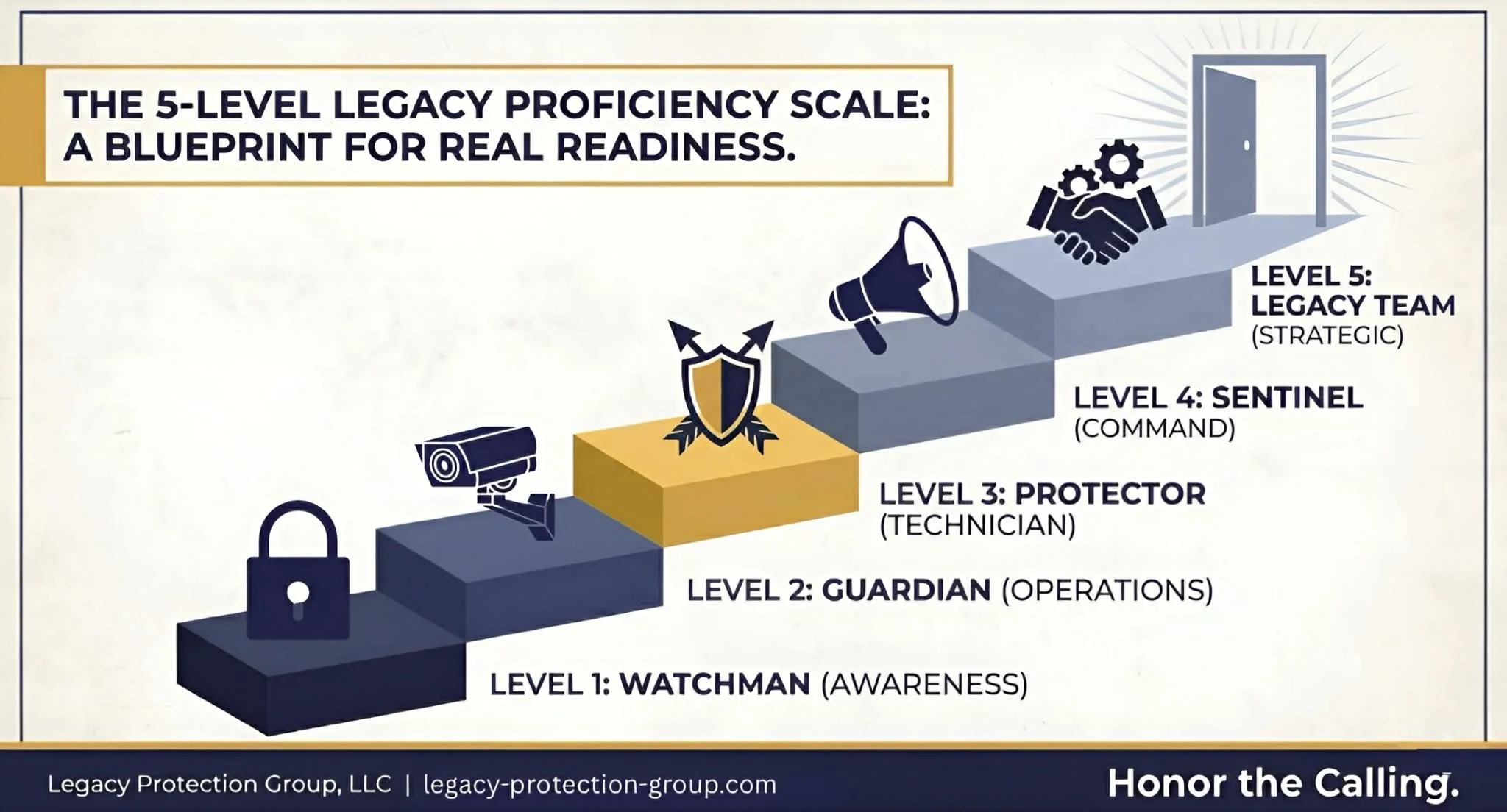

The 5 Levels of Legacy Proficiency
A Blueprint for Real Readiness
Most organizations believe they are prepared because they have a binder on a shelf. In the professional world, we call this a "plan on paper." While a plan is a start, it is not a proven capability. At Legacy Protection Group, we believe safety is a sacred responsibility. To help our partners in the River Region move from well-intentioned to truly ready, we utilize the 5-Level Legacy Proficiency Scale.
This scale is designed to measure and mature your organizational safety. It isn’t about "tactic-cool" hype; it’s about data-driven assurance and meeting a "Reasonable and Prudent" standard of care.
The Path to Proficiency
Level 1: Watchman (Awareness) – You have basic surveillance and a starting orientation, but remain vulnerable to "Paper Plan" syndrome.
Level 2: Guardian (Operations) – This is the signature LPG transition. We move beyond theory by establishing site-specific Emergency Action Plans (EAPs) and foundational medical readiness, such as verified AED maintenance logs.
Level 3: Protector (Technician) – Here, we validate individual proficiency. It’s about ensuring the right people have the right skills and equipment, like C-A-T Gen 7 Tourniquets, staged where they are needed most.
Level 4: Sentinel (Command) – Leadership takes center stage. We focus on incident command and team coordination to ensure a unified response during chaos.
Level 5: Legacy Team (Strategic) – The gold standard. Your organization achieves full resilience through validation and interoperability with local emergency services.
Stewardship in Action
True stewardship means knowing exactly where you stand today so you can build a safer tomorrow. Whether you are protecting a house of worship or a hallway of students, the goal is the same: Vigilance that stands up to the test of reality.
Are you operating on a feeling, or a proven capability?
Take the first step: Contact us today for a comprehensive audit of your Physical, Electronic, and Procedural layers to see where you sit on the scale.